The Documentary Method: Why Businesses Need to Stop Acting and Start Telling the Truth
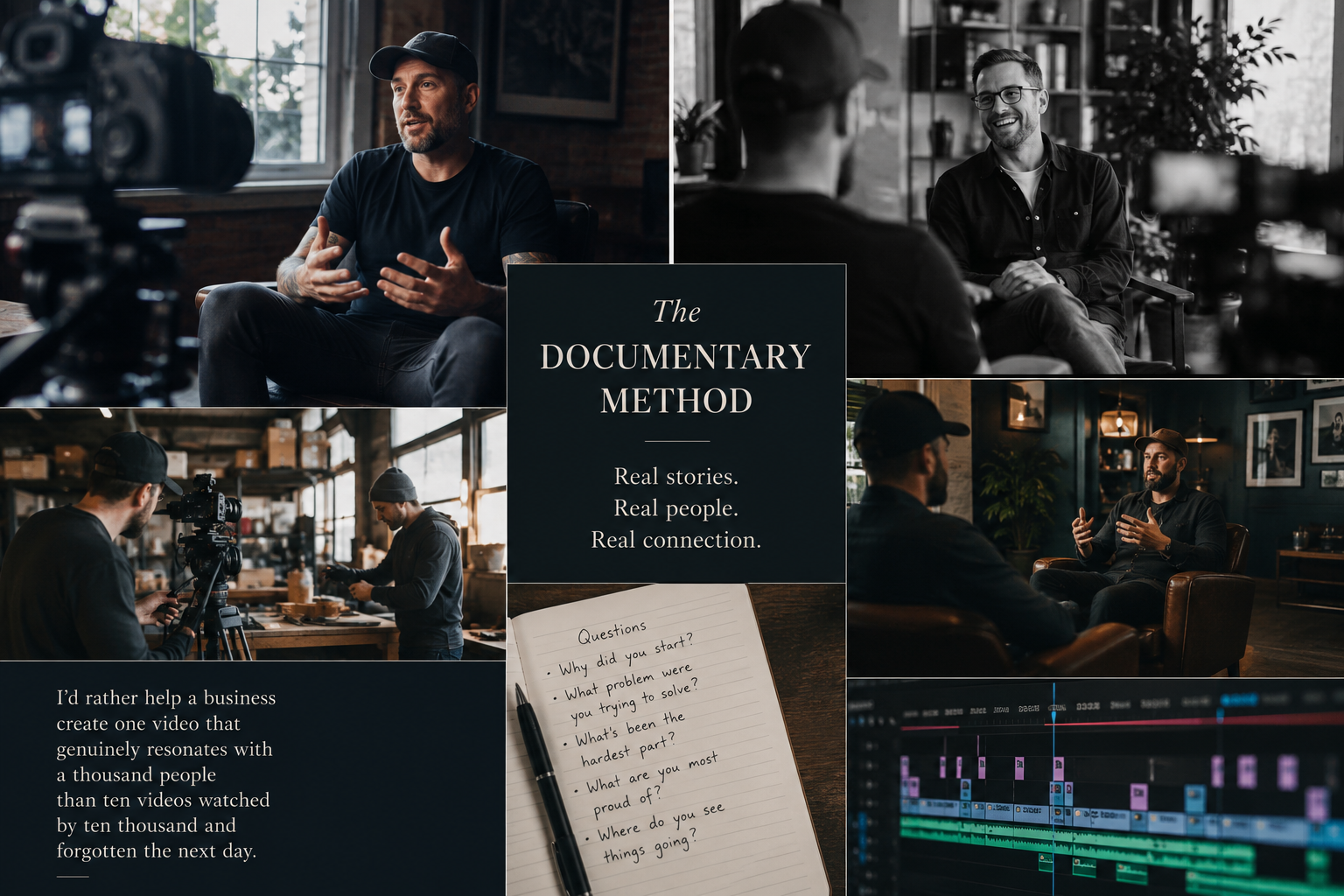
The Documentary Method - Digby Furneaux
I spend a great deal of my life behind a camera. Sometimes I'm filming interviews for a documentary, sometimes I'm shooting promotional films for businesses, and sometimes I'm simply observing people. The funny thing is that after years of doing this, I've come to the conclusion that people are at their most interesting when they forget they're being filmed.
It's a strange contradiction because most businesses approach video in exactly the opposite way. They prepare scripts, rehearse lines and try to become a polished version of themselves. They spend hours worrying about what to say and how to say it. They watch videos from marketing gurus who tell them they need a stronger hook, more energy, quicker edits and captions that bounce around the screen to keep people's attention.
And I understand why they do it.
We're all swimming in the same sea of advice. Every day we're told that attention spans are shrinking and that if we don't grab somebody in the first two seconds we've lost them forever. We are taught to chase views, optimise retention and study algorithms as though they are some mysterious force controlling our success.
Yet I can't help but wonder whether we're chasing the wrong thing.
A few evenings ago I found myself scrolling through social media and realised I couldn't remember a single video I'd watched in the previous half hour. I'd seen plenty of them. In fact, I'd probably watched dozens. They were expertly edited, packed with music and transitions and designed with surgical precision to keep me engaged.
But none of them stayed with me.
Then I thought about the videos I do remember.
I remember a documentary where a man paused for what felt like an eternity before talking about losing his wife. Nothing happened in that pause. There was no music swelling in the background and no dramatic zoom. He simply sat there trying to find the words. Yet I remember that moment years later because it was honest.
I remember interviews where people forgot they were supposed to be performing and started talking like human beings. I remember awkward laughs, unfinished sentences and moments of vulnerability that no scriptwriter in the world could have invented.
Those moments are powerful because they reveal something real.
And the more I think about it, the more I believe that's what audiences are actually searching for.
Not perfection.
Not clever editing.
Not another person pointing at text on a screen.
People are searching for connection.
This matters enormously for businesses because businesses are built on trust, and trust is built when people feel they know you. It's why we return to the same coffee shop, recommend the same tradesman or choose one company over another even when the products are almost identical.
We buy from people.
And yet so much business video seems designed to hide the people behind the business.
It replaces personality with polish. It smooths out imperfections and edits away the pauses. It creates a carefully manufactured version of somebody because we assume that's what audiences want to see.
I'm no longer convinced that's true.
In fact, I think the opposite might be true.
I think people are becoming increasingly good at spotting when they're being marketed to. We can all sense when somebody is reading from a script or following a trend they've seen online. We might watch for a moment, but we rarely connect.
Connection comes from authenticity, and authenticity is difficult to fake.
That's why I've started approaching business video in a completely different way, something I call The Documentary Method.
The premise is surprisingly simple. Instead of arriving with a script, I arrive with questions. Instead of telling people what to say, I ask them why they started their business. I ask what frustrates them about their industry, what keeps them awake at night and what makes them proud.
At first, people are nervous. Most of us aren't used to speaking openly on camera. We think we need to perform.
But something interesting happens after ten or fifteen minutes.
People relax.
They stop searching for the perfect answer.
They forget the camera is there.
And suddenly they're telling stories.
They're talking about the customer who changed their perspective on their business. They're explaining why they took a risk when everyone told them not to. They're laughing about mistakes they made in the early days or becoming emotional when they describe what success really means to them.
Those are the moments I look for.
Because those are the moments an audience connects with.
The beauty of this approach is that it isn't just more authentic, it's also incredibly practical. One long-form interview can become an entire library of content. A single conversation can provide a brand film, a series of short videos for social media, clips for a website and enough material to tell the story of a business in a way that feels genuine rather than manufactured.
More importantly, it allows people to see the real person behind the company.
And I think that's becoming increasingly valuable.
We've spent years optimising content for algorithms and chasing ever larger view counts. But views, on their own, don't build businesses. I've seen videos with hundreds of thousands of views leave no impression whatsoever, while a simple, honest conversation watched by a few thousand people creates genuine trust and lasting relationships.
I'd take the latter every single time.
Because a thousand people who truly understand who you are and what you stand for are infinitely more valuable than ten thousand people who barely remember watching your video.
Perhaps that's an old-fashioned view.
Or perhaps, in a world saturated with noise and performance, telling the truth has become a radical act.
I don't know if The Documentary Method will become the next marketing trend, and to be honest I'm not particularly interested in whether it does.
What I do know is this: when people stop acting and start telling the truth, audiences notice.
And in the end, I think that's what great filmmaking—and great business—is really about.